A laboratory report appears authoritative because it is numerical. The value is printed beside a range, often followed by a reassuring “normal” or an alarming flag. Yet the range answers a narrower question than most readers assume.
What a reference interval actually describes
A conventional reference interval usually describes the central portion of values observed in a selected population. It is a statistical description—not a border between health and disease. By construction, some healthy people fall outside it. A person can also fall inside it while carrying meaningful risk.
The population matters. Age, sex, preparation, assay method, medication, illness, and selection criteria influence the range. “Normal” therefore means something closer to “common in this reference population under these conditions” than “optimal for this person.”
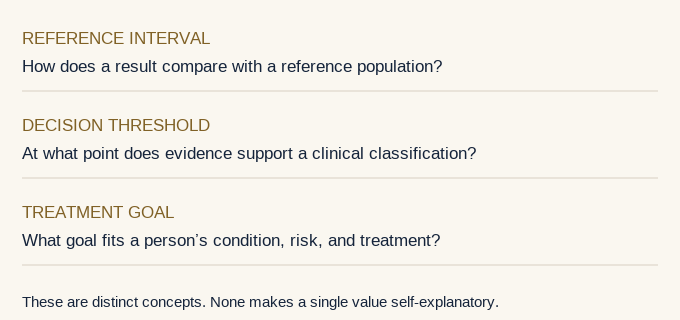
Three lines that are often confused
A reference interval describes a distribution. A risk threshold identifies a level associated with a change in probability. A treatment goal reflects evidence, baseline risk, expected benefit, burden, and clinical judgment. They may overlap. They are not interchangeable.
This is why replacing a laboratory’s upper limit with a more aggressive “optimal” number does not solve the interpretive problem. It may simply replace one oversimplification with another.
The same number can carry different meaning
A fasting glucose of 95 mg/dL can appear reassuring in isolation. Read beside rising fasting insulin, increasing triglycerides, declining HDL, expanding waist circumference, and a family history of diabetes, it may belong to a very different metabolic story. The glucose has not changed. Its context has.
Likewise, a single unexpected result may reflect preparation, recent illness, ordinary biological variation, analytical error, or regression to the mean. Repetition under comparable conditions can be more informative than immediate interpretation.
The four Book One pillars
What better interpretation sounds like
Better interpretation is rarely a stronger adjective. It is a better-qualified sentence: what was measured, compared with which standard, in whom, under what conditions, with what supporting pattern, across what period, and with what degree of uncertainty.
Measurement creates data. Judgment creates direction.
That judgment belongs in clinical context when personal decisions are at stake. General education can teach the questions. It cannot supply the individual answer.
Twelve Questions to Ask About Any Longevity Claim
Download the free one-page field guide.
Get the guide