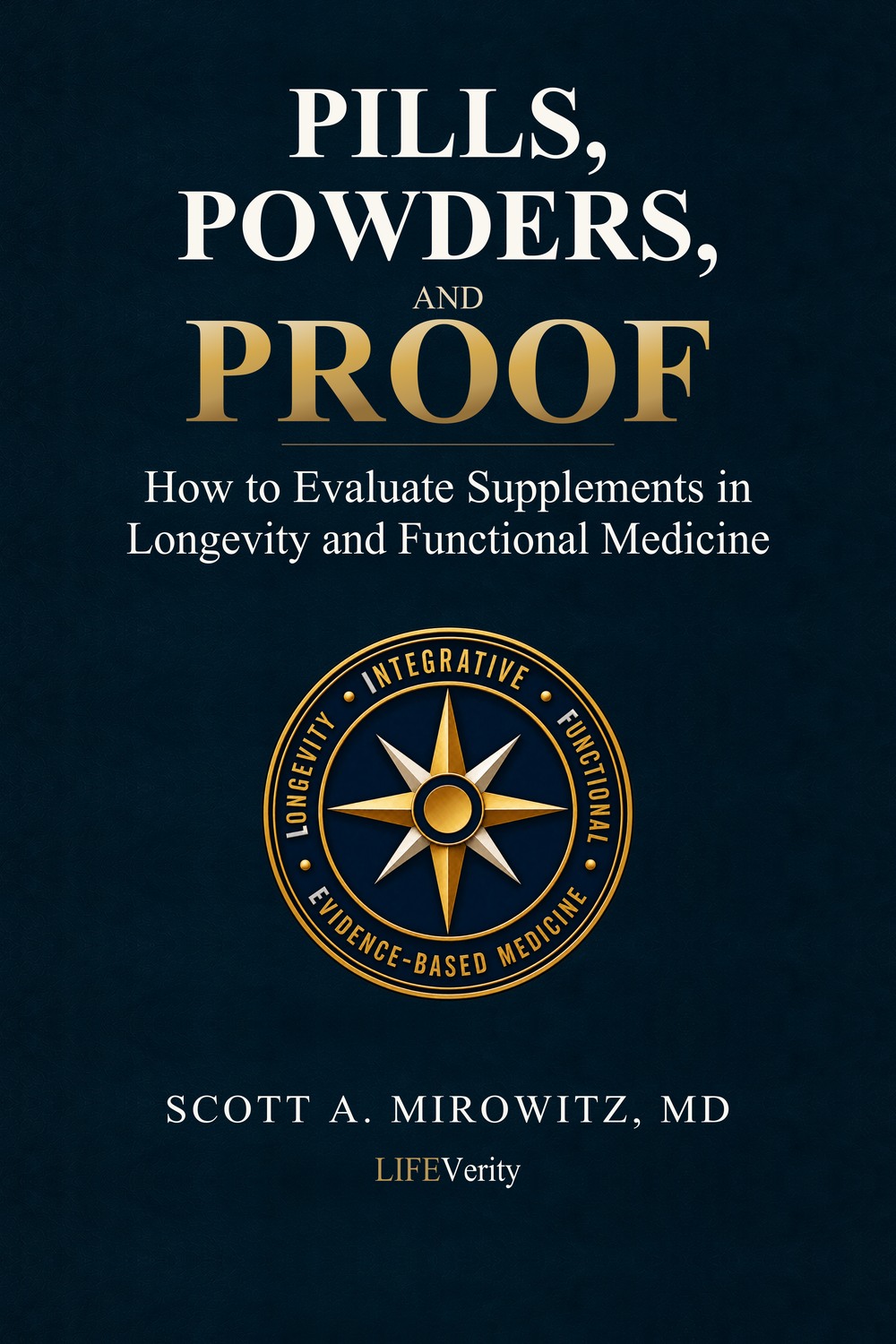
Pills, Powders,
and Proof
How to Evaluate Supplements in Longevity and Functional Medicine
Is that supplement likely to help you—or simply add expense and risk to your routine? Pills, Powders, and Proof helps you use evidence to assess a product’s promised benefits, the dose and formulation studied, and potential side effects or interactions. Learn what to ask before you buy, what to discuss with your clinician, and when the evidence is too uncertain to justify a confident recommendation.
By Scott A. Mirowitz, MD, medical school professor as well as a longevity and functional medicine physician.
Make your next supplement decision a better-informed one.
A persuasive label cannot tell you whether a supplement is a sensible choice for you. This book helps you examine the evidence behind the promise and prepare for a more useful conversation about benefits and safety.
- Check whether the product resembles the formulation and dose actually studied.
- Look beyond marketing to the size and reliability of the reported benefit.
- Identify questions about side effects, interactions, and adding another product to your routine.
A supplement recommendation becomes a recurring expense. What justifies it?
You are offered another product for your daily routine. The label sounds reassuring, but you are unsure whether the research applies to that product or to the reason you would take it.
The book helps you ask whether the formulation and dose match the research, whether the benefit matters to you, and what safety or interaction questions need review. You can bring a clearer reason for considering the product to your clinician.
Read a free previewDistinct questions.
A connected perspective.
All four books in the LIFEVerity Series, bundled together to form an authoritative and comprehensive resource for evaluating tests, claims, interventions, and supplements in longevity and functional medicine.
Explore each book individually or discover how they work together. All four books are in press.
Explore the collection →Inside Pills, Powders, and Proof
What a supplement purchase can add up to
Read why recurring expense, the outcome you hope to achieve, and the formulation studied all belong in a supplement decision.
View the table of contents · 30 chapters
- What Americans Actually Buy
- Understanding the Verdicts
- Why Most Supplement Trials Cannot Answer Your Question
- Deficiency, Sufficiency, and the Space Between
- Why the Shelf Is the Way It Is
- What Is Actually in the Bottle
- Which of These Is You?
- The Foundational Nutrients
- Sleep
- Mood, Anxiety and Stress
- Cognition and Memory
- Strength, Power and Training
- Endurance, Energy and Fatigue
- Weight and Body Composition
- Blood Sugar and Insulin
- Heart, Lipids and Blood Pressure
- Joints, Bone and Connective Tissue
- Pain and Inflammation
- Gut, Digestion and the Microbiome
- Immunity and Infection
- Skin, Hair and Nails
- Eye and Vision
- Liver and Detoxification
- Hormonal, Sexual and Urinary Health
- Pregnancy and Children
- Greens and Other Natural Products
- The Longevity Shelf
- The Recurrent Cost Effect
- Redundancy, Interaction and the Crowded Shelf
- What to Stop, and How You Would Know
Read the sample from the introduction
From Method to Merchandise
The purpose of this book is to make that assessment practical. A supplement decision needs the same attention to evidence, uncertainty and personal relevance as any other health decision.
Some interventions have a defined course and an outcome that can be reviewed promptly. Others, including many supplements, are continued for months or years. In either case, an unproven, inexpensive option still requires a reason to try it, an assessment of risk and a plan for review. A change noticed or reported by one person does not settle the question of efficacy.
Three features of continued use deserve particular attention.
The first is arithmetic. Forty dollars a month becomes $4,800 over ten years, before any price changes. Several individually modest purchases can become a substantial recurring expense. Chapter 28 considers that expense alongside expected benefit, safety and the burden of taking the products.
The second is whether the outcome can be noticed. Relief of a symptom may be apparent; prevention of a future event usually is not. A change in a laboratory marker may help answer one question without proving a broader health benefit. Continued use therefore needs a review plan suited to the actual claim.
The third is uncertainty. Years of use and commercial availability do not establish efficacy. When relevant trials are missing, the claimed benefit remains unresolved. That uncertainty belongs in the decision, but it is not proof that the compound fails or an explanation of why it has not been studied.
My purpose is to make the distinctions useful: where there is a supported benefit, where the findings are mixed, where a tested claim has not held up, and where the question has barely been examined. Favorable and unfavorable results deserve the same scrutiny.
The most useful answer is often narrower than the question a reader first brings.
The evidence shows that compounds tend to work for a narrower group and claim than the label suggests. Iron treats iron deficiency; routine iron for unexplained tiredness has no comparable basis, and correcting anemia does not remove the need to identify its cause. Vitamin D treats deficiency, but routine supplementation has not prevented fractures in generally sufficient, community-dwelling adults. Selenium has evidence for selected patients with mild thyroid eye disease and does not prevent cancer. A compound therefore receives a separate verdict for each use. One favorable result cannot be transferred to everyone buying the same bottle.
Missing evidence is not the same as evidence of failure. A well-designed study can give a useful negative answer for the population, dose and outcome it tested. A small or imprecise study may leave the question open. Funding, feasibility and research priorities affect what gets studied, but the reason for an evidence gap cannot be assumed from the gap alone.
Form and dose also matter. Different salts, extracts and delivery systems can produce different exposures. Red yeast rice may contain monacolin K, chemically identical to lovastatin, but its amount varies among products. A study of one preparation does not automatically establish the effect of another. The entries identify those distinctions where they change the interpretation.
Selected passage from the introduction to Pills, Powders, and Proof. © 2026 Scott A. Mirowitz, MD. The full introduction and chapters provide further context and supporting material.
Know when it is ready.
Receive publication updates about Pills, Powders, and Proof. This is separate from The LIFEVerity Letter.
The request could not be sent. Please email contact@lifeveritymd.com.