Moving the Needle
How to Evaluate Interventions in Longevity and Functional Medicine
Before you commit to a longevity or functional medicine intervention, understand what you may gain—and what it may cost you in risk, money, and effort. Moving the Needle helps you use evidence to judge whether an intervention offers meaningful health benefits, who may benefit, and how it compares with alternatives. Bring clearer priorities and better questions to decisions about your care.
By Scott A. Mirowitz, MD, medical school professor as well as a longevity and functional medicine physician.
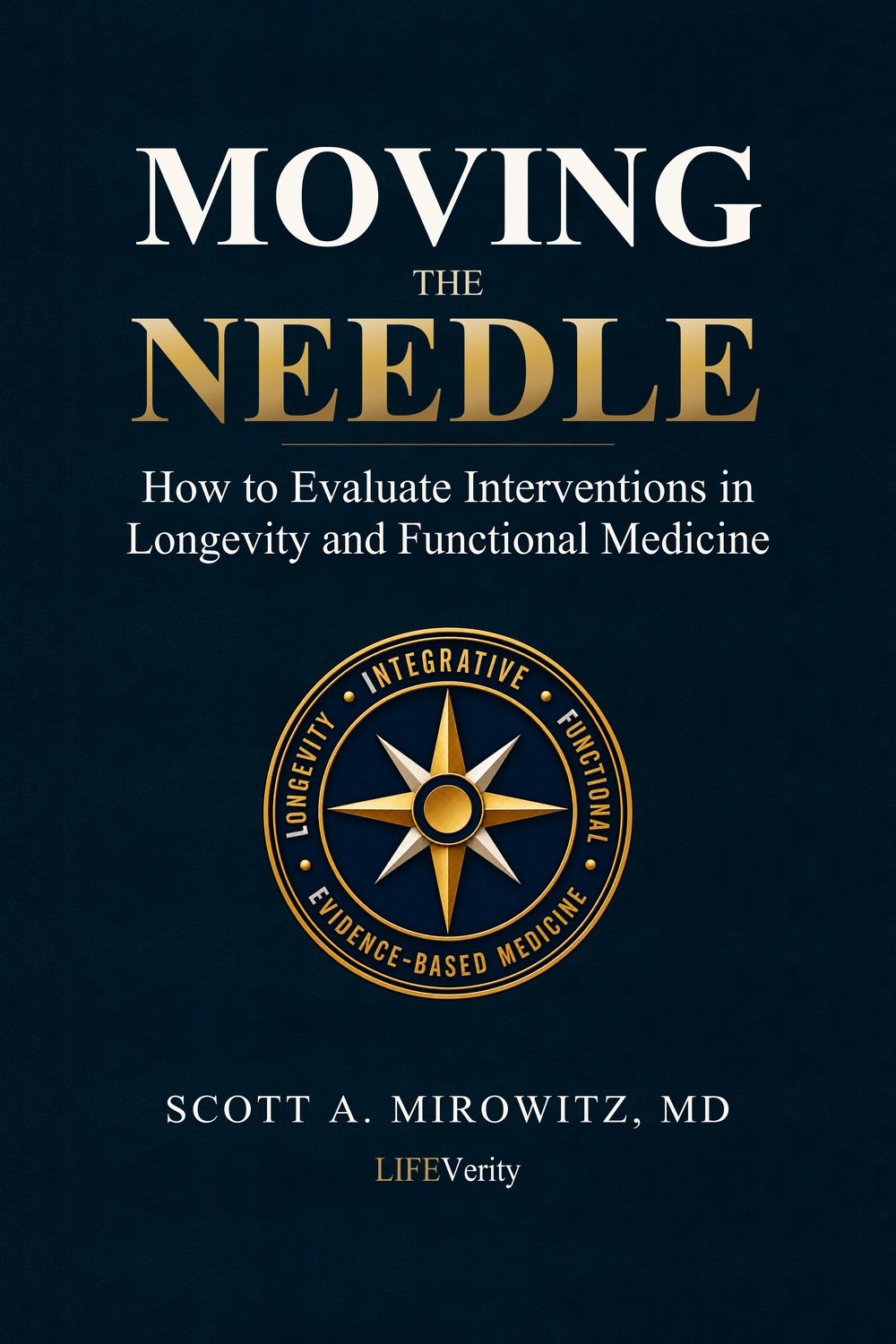
Decide what is worth pursuing for your health.
Your time, money, and tolerance for risk are limited. Use this book to compare longevity and functional medicine interventions with a clearer view of what they may offer and what remains uncertain.
- Ask whether a better test number translates into a health benefit that matters.
- Weigh potential benefits against harms, costs, and the burden of treatment.
- Discuss alternatives and what would count as meaningful progress with your clinician.
An expensive longevity program sounds promising. Is it worth pursuing?
You are considering an intervention that requires repeated visits, a substantial payment, or changes to your daily life. Testimonials are enthusiastic; the expected benefit is less clear.
The book helps you compare evidence of meaningful health benefits with the risks, costs, and effort involved. It gives you questions to discuss with your clinician about alternatives, uncertainty, and how you would judge whether the intervention is helping.
Read a free previewDistinct questions.
A connected perspective.
All four books in the LIFEVerity Series, bundled together to form an authoritative and comprehensive resource for evaluating tests, claims, interventions, and supplements in longevity and functional medicine.
Explore each book individually or discover how they work together. All four books are in press.
Explore the collection →Inside Moving the Needle
What makes an intervention worth considering?
See how the book separates a plausible explanation from demonstrated benefit and weighs the evidence alongside risk, cost, and your priorities.
View the table of contents · 18 chapters
- Hyperbaric Oxygen Therapy
- Ozone Therapy
- Molecular Hydrogen
- Light Therapy
- Frequency Medicine
- Intravenous Nutrient Therapy
- NAD⁺, Its Precursors, and the Longevity Molecules
- Therapeutic Plasma Exchange
- Peptides
- Hormone Therapy
- Repurposed Drugs
- Detoxification and Chelation
- Heat and Cold
- Psychedelic-Assisted Therapy
- Stem Cells, Exosomes, and PRP
- Acupuncture
- The Gut
- Manual Therapy
Read the sample from the introduction
Assessing the interventions
Some questions attract less funding than others. Patent protection, commercial incentives, practical difficulties and research priorities can all influence which trials are undertaken. Public and nonprofit funding also support work without a proprietary product. A missing trial does not establish why the evidence is missing.
When a verdict carries Evidence U, no relevant human evidence was identified for that population and use. That describes a gap in the literature reviewed, rather than a failure of the method. Funding may help explain the gap, alongside practical difficulties in recruitment, blinding or long follow-up. None of those explanations supplies the missing result.
The reverse holds with equal force. Where a trial was run and came back negative, that is a real finding, and this book reports it as one without softening. What we do not do is treat a question nobody funded as though it had been asked and answered.
Complex biological effects can require more than one measure. Even so, a study needs prespecified, clinically meaningful outcomes and an analysis that limits false-positive findings. A systems explanation cannot turn a negative result into evidence of an unmeasured benefit.
Where this book sits in the series
The first book in this series, The Biomarker Map, taught the reading of your own physiology—how to interpret a panel of numbers without being misled by them. The second, The LIFE Evaluation, built an instrument for weighing a health and longevity claim: a repeatable way to ask what the evidence behind the claim actually supports and arrive at a reliable decision about whether it makes sense for you. This book puts that instrument to work in the chapters that follow.
This book is a companion to The LIFE Evaluation: How to Evaluate Claims in Longevity and Functional Medicine, which describes the instrument applied throughout these pages—two questions leading to four possible verdicts, and the five evidence grades, A to D and U. In The LIFE Evaluation we applied the instrument to the six foundations of longevity medicine: exercise and movement, sleep, nutrition, social connection and purpose, stress management, and avoidance of toxic exposures. In this book, we apply it to the wide array of longevity related interventions that are represented in this substantial and growing marketplace.
Hyperbaric oxygen. Ozone. Molecular hydrogen. Light therapies. Frequency medicine. Intravenous nutrients. NAD⁺. Plasma exchange. Peptides. Hormones. Repurposed drugs. Detoxification and chelation. Heat and cold. Psychedelics. Stem cells and exosomes. Acupuncture. The gut. Manual therapy. Each is examined on its own terms, and each ends in a verdict and a grade.
One commitment governs the book: every method gets a fair hearing before it receives a verdict. Where something works, I say so plainly and explain why. Where it does not, I say that too, and I try to say what would change my decision. The verdicts here are not a defense of this field nor an attack on it. Many methods in these pages come out better than a conventionally trained physician would expect. Many come out worse than their advocates will like. That is what an objective instrument is for: it produces the answer it produces, and the facts as they currently exist are allowed to speak for themselves.
Keep in mind that a verdict is not a decision. This book can tell you where a method currently stands—how strong the evidence backing it, how heavy its risks and costs. It cannot tell you what to do, because that step is not strictly a matter of evidence but also depends on what you value, what you can afford, and how much uncertainty you are willing to carry in pursuit of a potential benefit. Two people can read the same verdict and rightly reach opposite conclusions. What the book provides you is the information that allows you to make that decision for yourself.
So: eighteen chapters, one instrument, and a question asked of each in turn. Is it worth it?
Selected passage from the introduction to Moving the Needle. © 2026 Scott A. Mirowitz, MD. The full introduction and chapters provide further context and supporting material.
Know when it is ready.
Receive publication updates about Moving the Needle. This is separate from The LIFEVerity Letter.
The request could not be sent. Please email contact@lifeveritymd.com.