Look beyond one number
Ask how a flagged result fits with your other results and the reason the test was ordered.
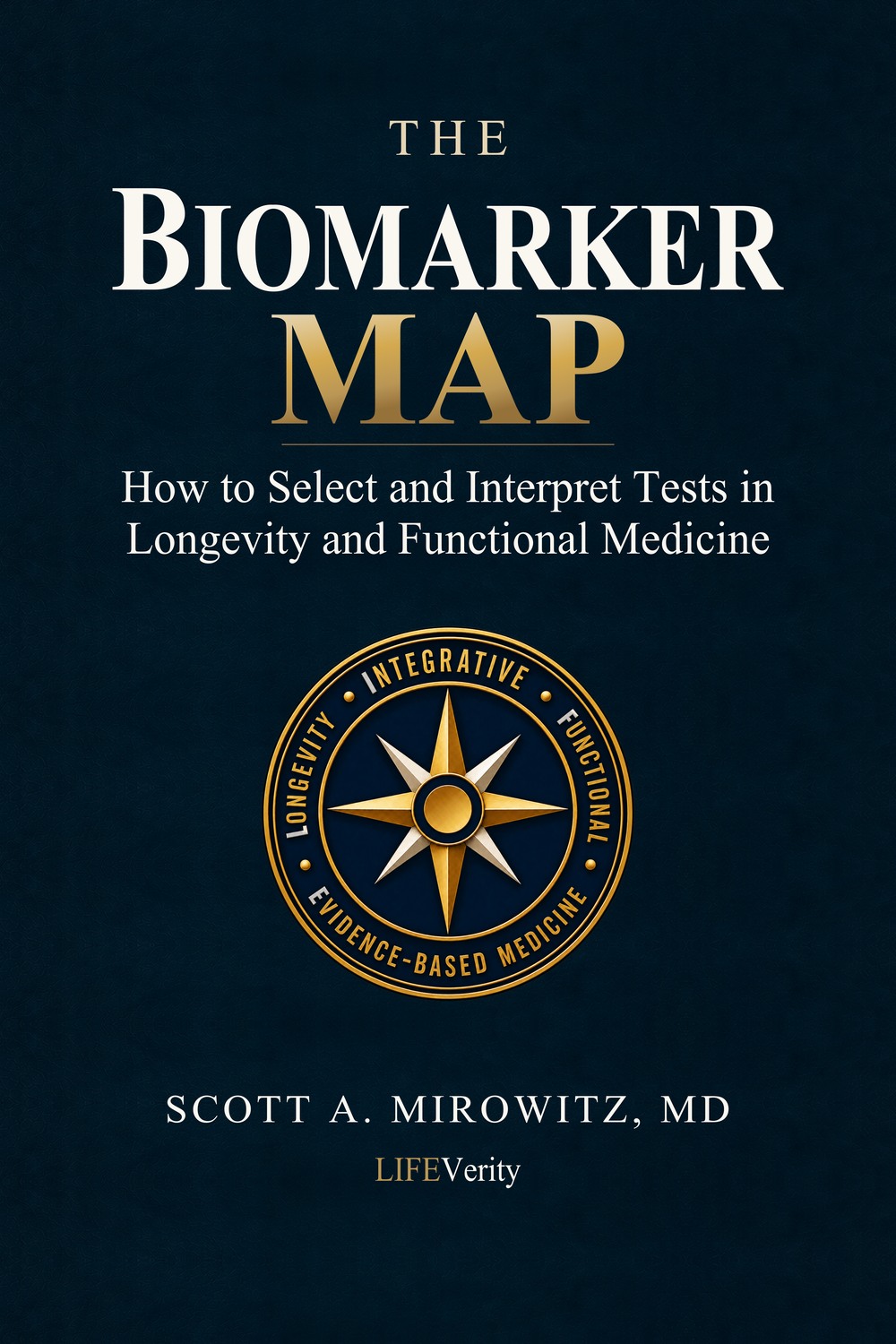
A flagged result can leave you worried. A “normal” result can leave important questions unanswered. The Biomarker Map helps you understand which tests may be useful, what your results can—and cannot—reveal, and what to ask your physician next. Learn to use evidence and context to avoid overreacting to a single number, question unnecessary testing, and make better-informed decisions about your health.
Written by Scott A. Mirowitz, MD, a diagnostic radiologist and medical school professor as well as a longevity and functional medicine physician.
A test report gives you numbers. You need to know what they mean for you. This book helps you prepare for a more useful conversation with your physician about which findings deserve attention, what could explain them, and whether additional testing would help.
Learn to look at results together, compare them over time, and ask how your circumstances affect their meaning. The goal is to help you avoid unnecessary alarm, misplaced reassurance, and testing that adds cost without answering a useful question.
Ask how a flagged result fits with your other results and the reason the test was ordered.
Prepare questions about factors your clinician may consider, including medications, illness, and when the sample was taken.
Learn why the history of a result can help you ask better questions about a new reading.
Ask how the findings fit your symptoms, health history, and goals—and what they could change about your care.
You open your results and see a number outside the reference range. You want to know whether it matters, whether another test would help, and what to discuss at your appointment.
The book helps you frame those questions: How does this compare with earlier results? What else could influence the measurement? Do related results tell the same story? Would more testing change a decision?
Read a free previewExplore common blood tests, heart and metabolic health, hormones, imaging, wearables, and newer measures of biological age. Learn what each can contribute, where its limits lie, and which questions are worth taking to your physician.
Explore the chapter previewUnderstand why a result inside or outside the printed range still needs context.
Learn what additional heart-health measurements may contribute to a discussion of risk.
Use worked cases and a personal record of results to organize better questions about your health.
Try two illustrations from the book to see how similar-looking results can conceal different patterns. They demonstrate questions to explore, not conclusions about your own health.
Drag through time. During the compensated phase, the pancreas secretes progressively more insulin to hold glucose near the same line. In this simplified model, glucose rises as compensation becomes insufficient.
Both examples carry the same cholesterol mass. Switch examples to see why the number of ApoB-containing particles can tell a different risk story.
Schematic educational figures. They do not estimate an individual’s insulin resistance, cardiovascular risk, or need for testing or treatment.
These short reference entries explain what a measurement tells you, what it can miss, and common misunderstandings. Sources are linked so you can explore the evidence behind the explanation.
Helps you understand test information, prepare better questions for your clinician, and weigh the reasons for further testing.
Interpret an individual reader’s results, diagnose disease, prescribe treatment, or replace care from a qualified clinician.
I wrote The Biomarker Map because the expanding ability to measure human biology has outpaced the ability to explain what those measurements mean. The goal is not more testing. It is better thinking.
Scott A. Mirowitz, MD
About the authorSee why “normal” and “abnormal” alone cannot settle what a result means for your health. This passage introduces the need to consider the whole picture before drawing a conclusion.
Chapter 4 introduces The LIFE Method, the book’s four-part framework for reading any result: Pattern Recognition, Context, Longitudinal Analysis, and Systems Integration.
Few words in medicine carry more authority—or create more misunderstanding—than normal.
Every day, millions of people undergo laboratory testing and receive reports listing dozens of measurements, each paired with a reference range. The emotional response usually comes down to a single question: was the result normal or abnormal? A value inside the range brings relief; a value outside it brings concern. Understandable as this is, it is also a considerable oversimplification.
One of the central themes of this book is that normal and optimal are not the same thing. A value can sit comfortably within a reference range and still carry important information about future risk, physiological reserve, or the earliest stages of dysfunction. Conversely, a value that falls slightly outside the range may mean very little, depending on the circumstances. Learning to tell these situations apart is essential to making sense of modern health information.
My appreciation for this developed gradually. As I described in the Introduction, much of my career was spent interpreting complex information and teaching others to do the same—reviewing imaging studies, researching diagnostic error, and participating in multidisciplinary conferences where the significance of a finding often shifted dramatically as context accumulated. A finding that looked alarming would often prove trivial once the full picture emerged; a subtle piece of information would often turn out to be the key. The lesson extended far beyond radiology: information and meaning are not the same. Information acquires meaning only through interpretation, context, and integration.
Excerpt from The Biomarker Map. © 2026 Scott A. Mirowitz, MD. The full chapter provides further context and supporting material.
The request could not be sent. Please email contact@lifeveritymd.com.
All four books in the LIFEVerity Series, bundled together to form an authoritative and comprehensive resource for evaluating tests, claims, interventions, and supplements in longevity and functional medicine.
Explore each book individually or discover how they work together. All four books are in press.
Explore the collection →